
Casino KYC and Verification for Australian Players
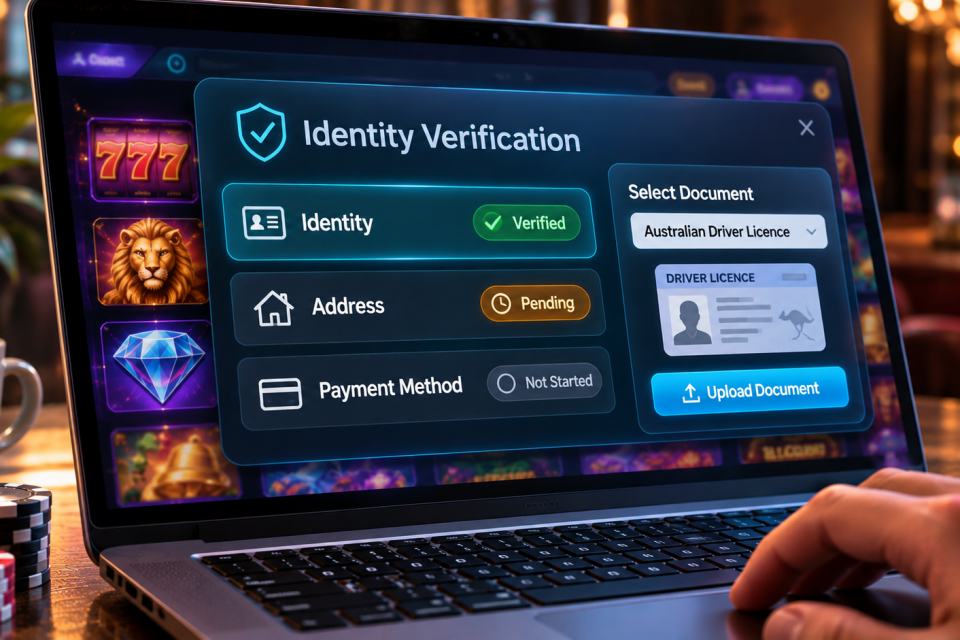
Twenty minutes of paperwork, done once, before anyone asks for it. That is the whole pitch for getting Casiny Casino verification sorted early. KYC shows up at every licensed casino sooner or later: a passport scan here, a utility bill there, a photo of the card used to deposit. Most players encounter it for the first time mid-withdrawal, which is the least convenient moment imaginable. The documents themselves are straightforward. The timing is what catches people out.
What the Process Covers
Not a sign that anything has gone wrong. KYC is closer to showing ID at a counter: routine, expected, over quickly when the details line up. It exists to prevent underage access, reduce fraud and confirm that deposits come from methods the account holder controls.
Three document areas come up most often:
| Check | Common documents | Purpose |
| Identity | Passport, driver licence, government photo ID | Confirms name and date of birth |
| Address | Bank statement, utility bill, council notice | Confirms current residential address |
| Payment method | Card image, bank record, e-wallet screenshot | Confirms control of the deposit method |
Not every casino asks for all three upfront. Some request documents only at the withdrawal stage, or after an unusual transaction. The help page states what is needed and in what format.
Identity Documents and Photo Quality

A passport or driver licence covers most identity requirements in one document. Some casinos ask for both sides of a licence. The document needs to be valid at the time of review. That part is obvious. The image quality part is where most rejections happen.
Poor light, clipped corners, glare across the card surface. Any of these gives the review team nothing to work with. Flat surface, natural light, all four edges in frame. That is the whole technique.
Editing a document image creates problems even when the intent is innocent. Filters and compression artefacts can make a legitimate file look altered. For a bank card, the middle digits are commonly covered while the name, first and last digits and expiry date stay visible, but only when the casino explicitly permits masking.
Proof of Address Has a Time Limit
Three months is the usual cut-off. A utility bill, bank statement or government letter works if it shows the full name, residential address and issue date. An older document may show the correct address and still fail the timing rule.
A mobile phone bill may also be rejected if the operator asks specifically for a bank statement. Checking the accepted list before uploading saves a round trip. Digital statements downloaded directly from the provider are generally fine. A PDF moves through review faster than a screenshot.
Payment Verification
This one tends to surprise people. Confirming that the deposit method belongs to the account holder is a standard step, not an exception. It is common before large withdrawals, when a payment method changes or when several deposit options have appeared across the account history.
For a card, the casino asks for an image showing the name and permitted details. The security code on the back is never required and should never appear. For an e-wallet, a screenshot of the account profile or transaction record showing the holder’s name usually covers it.
Withdrawals normally return through the method used to deposit. If that route is no longer available, support asks for more before offering an alternative. Using methods registered in the account holder’s name from the start avoids most of those conversations.
Timing
Completing verification before a withdrawal request removes the most common reason for a hold. It does not guarantee instant processing. Payment queues and bank timings still apply. But the account is far less likely to pause at an inconvenient moment.
Most delays trace back to a short list of avoidable situations:
| Situation | Practical response |
| Image rejected as unclear | Retake in daylight with all four edges visible |
| Address document too old | Download a current bank statement or bill |
| Name mismatch between account and card | Use a payment method held in the account holder’s name |
| Account details contain an error | Contact support before sending more documents |
Uploading the same file a second time rarely helps if the first was rejected for content, not quality. Comparing every account field against the documents before sending replacements is faster.
Privacy During the Process
Documents go through the casino’s official account area. Not a link in an email. Not a third-party chat window. The official account area, logged in, correct domain confirmed before attaching anything.
Public Wi-Fi is best avoided when sending identity files. No casino needs a card security code, an online banking password or a one-time code. Those open accounts; they do not verify one. A request for any of them is not a verification step.
Keep copies of what was submitted. Remove document images from shared devices once the process is complete. A passport scan in an open downloads folder is a loose end worth closing.
Before Requesting a Withdrawal
Verification removes one common reason for a hold, not all of them. A verified account still goes through wagering checks, payment route confirmation and the standard processing queue.
The cashier page shows minimum withdrawal amounts, supported methods and estimated times. A request with an unverified payment method or mismatched details comes back for clarification. Matching details and clear records keep that from happening twice.